


Why Fast Charging Amplifies Imbalance Risk in 72V EV bike battery Packs
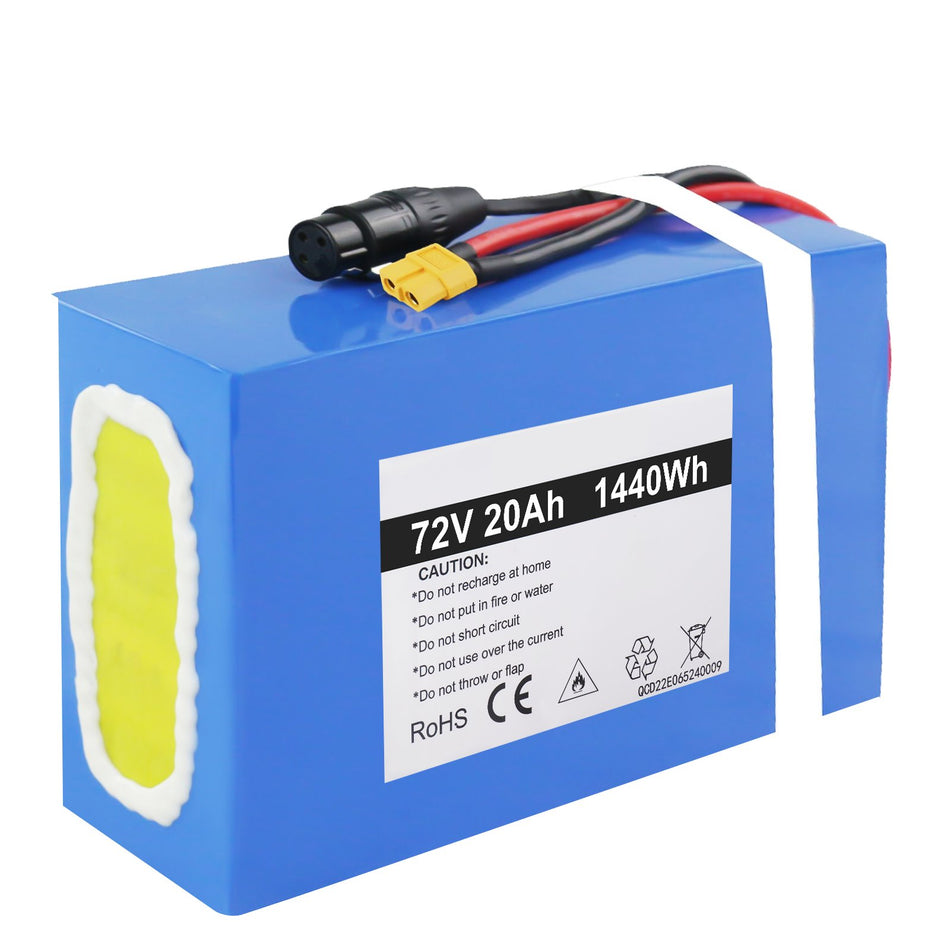
Fast charging has become one of the most requested features in modern electric bikes. Riders want shorter downtime, fleet operators want higher utilization, and manufacturers want competitive specifications. Yet beneath this convenience lies a serious engineering trade-off. In high-voltage systems, fast charging dramatically increases the risk of cell imbalance—especially in a 72V EV bike battery pack. This is not a theory; it is a repeatable failure pattern rooted in high-voltage battery fast charging dynamics, where voltage, current, and time interact in ways many systems are not designed to manage.
Understanding why this happens is critical for anyone building, operating, or replacing high-voltage EV bike batteries.
Why 72V Packs Are More Sensitive to Fast Charging
A 72V configuration requires a high number of cells connected in series. While this enables better efficiency and lower current draw during riding, it creates a fragile charging environment. During fast charging, even minor variations in cell internal resistance cause voltage divergence across the string. In a 72V EV bike battery, those small differences multiply rapidly.
Fast chargers push high current early in the cycle. Cells that reach voltage limits first begin to saturate, while others lag behind. Without perfectly tuned control logic, the pack appears “full” before all cells are equally charged. This is the foundation of imbalance—and once imbalance starts, it compounds with every subsequent charge.
The Constant-Current Phase Is the Primary Trigger
Most fast chargers rely heavily on an aggressive constant-current phase. While this reduces charging time, it places uneven stress on series-connected cells. Cells with slightly higher impedance heat faster and rise in voltage sooner. In a high-series pack, the 72V EV bike battery becomes vulnerable because the charger responds to total pack voltage, not individual cell health.
This behavior is especially problematic in systems where cell matching is imperfect or aging has already begun. Fast charging does not create imbalance from scratch; it amplifies existing differences at an accelerated rate.
Why LiFePO4 Chemistry Changes—but Does Not Eliminate—the Risk
LiFePO4 chemistry is often promoted as a solution for high-voltage stability, and for good reason. It offers a flatter voltage curve and improved thermal tolerance. This is why demand for 72V LiFePO4 electric bike battery replacement Pakistan solutions is growing in performance and commercial segments.
However, chemistry alone does not solve imbalance. LiFePO4 cells still drift under aggressive charging, especially near the upper state of charge. When fast charging pushes cells toward their voltage ceiling, imbalance develops if balancing currents cannot keep pace. The chemistry buys margin, not immunity.
Balancing Limitations Inside High-Voltage BMS Designs
Battery management systems are often misunderstood. Many are designed for safety cutoffs, not precision equalization under fast charge conditions. Passive balancing currents are typically small by design. During slow charging, this works. During fast charging, it does not.
In the middle of this discussion, it is critical to highlight cell balancing under fast charge conditions, because this is where many high-voltage packs quietly fail. In a 72V EV bike battery balancing circuits simply cannot bleed excess voltage fast enough when current remains high. The result is chronic overcharge on some cells and undercharge on others.
Thermal Acceleration of Imbalance
Heat accelerates every imbalance mechanism. Fast charging raises internal temperatures unevenly across the pack. Cells that run hotter exhibit lower resistance, which causes them to accept charge faster—worsening voltage divergence.
This is a major concern in hot climates and dense urban use cases, where 72V LiFePO4 electric bike battery replacement Pakistan demand is often driven by premature degradation rather than calendar age. Without temperature-adaptive charging logic, fast charging turns minor thermal differences into permanent electrical imbalance.
Long-Term Effects Riders Rarely Connect to Charging
Imbalance does not announce itself immediately. Riders notice reduced range, sudden shutdowns under load, or inconsistent performance. Over time, the weakest cell dictates the usable capacity of the entire pack. In high-voltage systems, this happens faster because the margin for error is smaller.
Fleet data consistently shows that fast-charged packs lose usable capacity sooner, even when total charge cycles appear reasonable. In many failed systems, the 72V EV bike battery cells were still chemically healthy—the pack failed because imbalance crossed the BMS safety threshold.
Replacement Trends Reveal the Pattern
Replacement markets often tell the truth before marketing does. The steady rise in 72V LiFePO4 electric bike battery replacement Pakistan demand reflects users seeking stability after experiencing imbalance-related failures. Many replacements occur not because of catastrophic damage, but because balancing drift made the original pack unreliable.
This pattern reinforces an important lesson: fast charging is not free performance. It must be engineered, managed, and limited with discipline.
How Smart Charging Preserves High-Voltage Packs
Experienced engineers treat fast charging as a conditional feature, not a default mode. Current limits are adjusted based on temperature, state of charge, and cell deviation. Voltage ceilings are intentionally conservative. Balancing time is protected, not rushed.
At Hybridev Engineering, charging strategies are designed to preserve long-term pack symmetry rather than chase headline specifications. This approach consistently extends service life and reduces replacement frequency—especially in high-voltage deployments.
Final Perspective: Speed vs Longevity
Fast charging will remain a valuable feature, but only when applied intelligently. In high-voltage systems, imbalance is the hidden cost that separates durable designs from disposable ones. Riders and operators who understand this trade-off make better decisions—both at purchase and replacement time.
For proven guidance on high-voltage EV battery systems and responsible charging strategies, visit Hybridev Engineering, and align your designs with engineering practices that prioritize longevity over short-term convenience. The continued growth of 72V LiFePO4 electric bike battery replacement Pakistan proves that the market ultimately rewards reliability.

 English
 Arabic
 French
 Spanish
 Portuguese
 Deutsch
 Turkish
 Dutch
Dutch
 Russian
 Romaian
 Portuguese (Brazil)
 Greek
Greek